
Most people call us with the same question buried about ninety seconds into the conversation. They’ll describe the ceiling stain, or the tenant complaint, or the adjuster asking for photos, and then they get to it: what does a drone roof inspection cost?
It’s a reasonable thing to want upfront, and roof work has never been great about answering it. Aerial inspections are newer, so people assume they’re either suspiciously cheap or reserved for corporate budgets. Neither is true. Here’s what the pricing looks like in Houston and what sits behind the number.
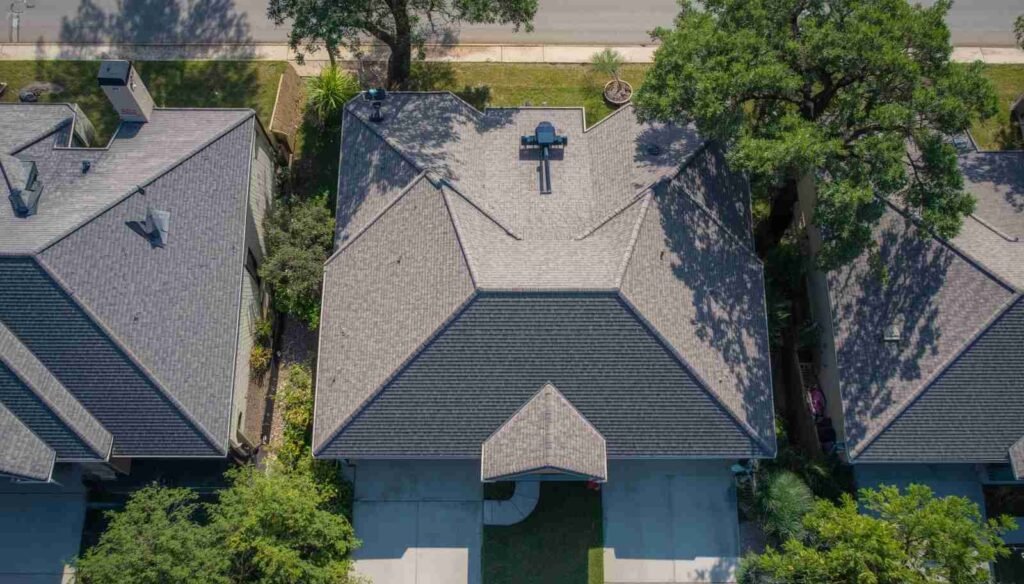
Drone roof inspection cost in Houston: the ranges
| Property type | Typical range |
|---|---|
| Single-family home, visual inspection | $150 – $350 |
| Large home, multiple structures, or a complex roofline | $300 – $600 |
| Small commercial or retail, visual | $400 – $900 |
| Commercial flat roof with a thermal scan | $600 – $2,000+ |
| Warehouses, industrial sites, multi-building portfolios | Quoted per square foot with a site minimum |
One caution about the bottom of that range. If someone quotes you $75, what you’re buying is a guy with a consumer drone and no certification, and what you’ll get back is a folder of blurry photos. An adjuster won’t work from it and your roofer won’t learn anything from it.
What changes your drone roof inspection cost
Roof size and layout
A gable roof on a 2,200 square foot house is maybe twenty minutes of flying. A 400,000 square foot distribution center off Beltway 8 is a planned mapping mission with battery swaps and hours of processing afterward. Same drone, different job entirely.
Visual or thermal
This is the biggest swing in any drone roof inspection cost. A standard visual pass shows you the surface: lifted shingles, punctured membrane, ponding water, torn flashing, drains that stopped draining. Thermal imaging shows you what’s under it. Wet insulation gives up heat at a different rate than dry insulation, so a radiometric sensor picks out saturated areas that look perfectly normal in daylight. That sensor costs several times what a standard camera does, and the flight has to happen in a narrow window after sunset while the roof is still releasing heat. You’re paying for the equipment and the scheduling, not for extra pictures.
What you get handed at the end
Raw imagery is cheaper than a report somebody spent three hours annotating. If you need something an adjuster or a building owner will read without you translating it, that’s back-end time. Worth asking about before you compare two quotes, because a $400 job and a $900 job are sometimes the same flight with very different paperwork attached.
Airspace, turnaround, and travel
Airspace matters more here than in most cities. A lot of Houston sits inside controlled airspace thanks to Hobby, Bush, and Ellington, and flying there means authorization through LAANC first. Most requests clear in seconds. Some grids need further coordination with the FAA, which takes days and occasionally moves a flight to a different time of day. Any real quote already accounts for that planning.
Beyond that: rush delivery costs extra if you’re against a claim deadline, standard turnaround is two to three business days, and anything past about ninety minutes out toward Galveston or Brazoria County picks up a trip charge. Katy, Sugar Land, Pearland, the Woodlands, inside the Loop, all standard.
When thermal is worth the extra money
A visual inspection tells you where the roof is damaged. Thermal tells you where the water ended up. Those are not always the same spot, and in Houston they usually aren’t.
Water gets in at a seam, runs sideways under the membrane, and surfaces as a stain thirty feet away. Cut open the ceiling under the stain and you find dry decking and a bill for the drywall repair. We got into that problem in more depth in our post on finding roof leaks with thermal imaging.
So: documenting hail damage after a storm, visual is generally plenty. Chasing a leak nobody can pin down, or deciding whether a 15-year-old TPO roof needs a $12,000 repair or a $180,000 replacement, thermal earns its cost the first time it stops you from tearing off a section that was fine.
Drone roof inspection cost vs. sending someone up a ladder
Traditional inspections aren’t free. Add up crew time, a lift rental for anything above two stories, safety setup, and people walking around on a roof during business hours, and the gap closes quickly. On a large commercial building the drone wins on price outright. On a single-story roof with easy access, it’s closer to a wash.
Documentation is where it isn’t close. You end up with timestamped, geotagged coverage of the entire roof surface instead of a dozen phone shots taken from wherever the inspector could safely stand. That difference shows up during a claim. The Texas Department of Insurance says as much in its storm recovery guidance, which tells homeowners to photograph everything and hold onto damaged material until the adjuster has seen it. Full aerial coverage is about as complete as that gets.
We compared the two approaches side by side here: drone roof inspections vs. traditional roof inspections.
The expensive inspection is the one that misses something
Something small gets overlooked in June. By September the insulation under it is saturated, and Houston humidity is not going to dry it out for you. Now the conversation isn’t about patching a seam, it’s about replacing decking and answering questions about mold.
At that point nobody remembers whether the inspection was $300 or $700.
What’s included when you book with us
An ISKY aerial inspection comes with a Part 107 certified pilot, insurance, airspace clearance sorted out before we arrive, full high-resolution coverage of the roof, and a report you can hand straight to a roofer or an adjuster. Thermal is available as an add-on or on its own.
If you’re managing multiple properties, we also run inspections on a set schedule, annually or twice a year. There’s more on that in when a commercial building needs a drone inspection and why Houston businesses are switching to drone roof inspections.
Questions we get a lot
How much does a drone roof inspection cost in Houston? Residential usually lands between $150 and $350. Commercial visual inspections start around $400, and thermal scans on commercial flat roofs generally begin near $600 and scale with square footage.
Is it cheaper than a traditional inspection? On large or hard-to-reach roofs, yes, mainly because there’s no lift rental and no crew standing around. On a small simple roof the two are comparable, though you still get much better documentation.
Will insurance accept a drone report? Adjusters work from evidence, and an annotated aerial set is solid evidence. It doesn’t replace their own inspection, but it supports the claim and puts a dated record of the roof’s condition on file.
How long does it take? Under an hour on site for most homes. Commercial depends on size. Reports usually go out in two to three business days.
Do you need FAA approval to fly over my property? If you’re near Hobby, Bush, or Ellington, yes. We take care of it, and it’s normally approved before we leave the office.
Get a real number
Ranges only tell you so much. Send us the address and the roof type and we’ll quote your drone roof inspection cost, usually the same day.
Contact ISKY Drone Services or call 713-582-2246.